
Inclusion Strategy and the Inclusive Mainstream Fund
Inclusive by design
At Bishop Creighton Academy, our ambition is to be inclusive by design. This means planning our teaching, curriculum, wider opportunities, culture and environment so that all pupils can achieve, belong, and thrive. We aim to identify and reduce barriers before they become established, while providing timely and effective additional support when pupils need it.

What is the Inclusive Mainstream Fund?
The Inclusive Mainstream Fund (IMF) is additional funding provided by the Department for Education to help mainstream schools strengthen inclusive practice.
The funding is intended to help schools:
- develop a strong, inclusive universal offer for all pupils;
- strengthen high-quality, adaptive teaching and curriculum access;
- recognise and respond to additional needs earlier;
- remove commonly occurring barriers to learning and participation; and
- provide early, evidence-based support for pupils who need more than the universal offer alone.
The IMF is used alongside the academy’s core funding, including its notional special educational needs budget.
What is an inclusion strategy?
Our Inclusion Strategy explains how we are developing inclusive practice across the academy and how we are using our IMF allocation.
Our strategy:
- describes our academy’s approach to inclusion;
- identifies the commonly occurring barriers to learning and participation experienced by our pupils;
- explains the evidence we have used to understand these barriers;
- sets out the activities we have prioritised;
- shows how these activities are supported by research and evidence;
- identifies the intended outcomes and how progress will be measured;
- explains how the strategy will be implemented, monitored and reviewed; and
- shows how the IMF has been allocated.
The strategy is based on the needs of pupils at Bishop Creighton Academy. It has been informed by a range of evidence, including academy information, classroom practice, staff expertise and the views of pupils and families.
The strategy is not intended to list every inclusive practice or form of SEND support available at the academy. It identifies a focused number of priorities where additional investment and development are expected to make the greatest difference. The Department for Education recommends that schools implement fewer approaches well, with attention to quality, consistency and impact.
Our universal offer and targeted support
A strong universal offer is the foundation of our inclusion strategy. This means high-quality teaching, curriculum design, routines, relationships and environments that anticipate a range of common needs and enable as many pupils as possible to succeed alongside their peers.
High-quality, adaptive teaching is particularly important because it benefits all pupils and is the most significant school-based influence on outcomes, especially for pupils with SEND.
Some pupils require additional or targeted support. Our inclusion strategy also sets out how we are developing our targeted provision so that appropriate support is always available.
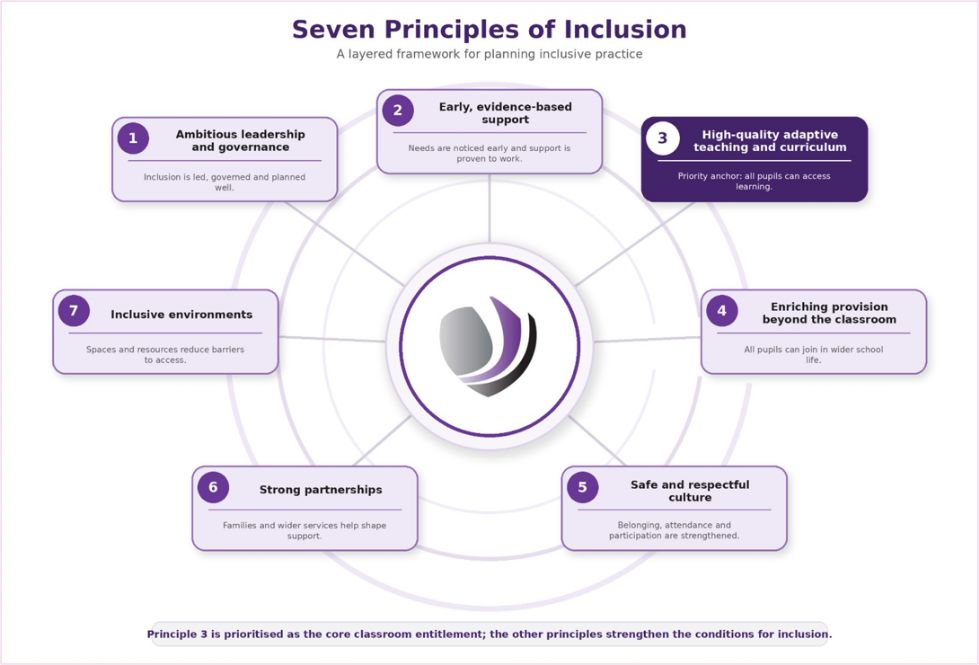
The seven principles of inclusion
Our strategy is built around the Department for Education’s seven principles of inclusion.
How we developed our strategy
We used an evidence-informed process to develop our Inclusion Strategy.
This included:
- identifying commonly occurring barriers to learning and participation;
- considering what pupils, families and staff told us;
- reviewing relevant academy information and current practice;
- identifying what is already working well and where practice needs to be strengthened;
- considering research and evidence about effective inclusive practice;
- selecting a manageable number of high-impact activities;
- identifying intended outcomes and success criteria; and
- planning how each activity will be implemented, monitored and evaluated.
How we monitor and evaluate the strategy
Leaders monitor both implementation and impact. This means we consider:
- whether planned activities are taking place;
- whether staff have the knowledge, resources and support needed;
- how consistently and effectively approaches are being used;
- what pupils and families experience;
- whether the intended pupils are benefiting;
- what academy information shows about access, participation, independence, belonging, attendance, behaviour, wellbeing, attainment and progress; and
- whether activities need to be sustained, adapted, strengthened or stopped.
The strategy is reviewed during the year and evaluated formally at the end of the academic year. Findings inform future academy improvement planning and the next version of the strategy.